Showing posts with label vegetables. Show all posts

Tuesday, October 25, 2011

Learning more!

     Tis the season for conferences, seminars and workshops it seems.  Lee is off for a few days to Birmingham for Alabama Urban Forestry  / International Society of Arboriculture (gotta keep those CEUs coming) conference so I slid into the Master Gardener's Fall Workshop at the Extension Office ACES on Cook Ave today in his place.  
     First up was Dottye Pierce (President MGNA) and Ken Creel (extension agent for this area) for the welcome and overview of their organizations.  Then we were treated to Janet Boothe's talk on Flower Bulbs.  Such gorgeous pictures of all the types of tulips and daffodils and crocus as well as the more unusual frittaria and snowdrops.  New to me was the botanical species tulips, the forerunners to our modern hybridized tulips.
Tulipa chyrsantha - Courtesy Wiki Commons


Tulipa turkestanica - Courtesy Wiki Commons


She included lots of good information on planning and planting so I hope to see more bright colors around town!


     Ed Gray spoke next on cold frames.  TONS of good ideas here from the simplest to the most elaborate.  I loved the hay bales with an old window on top, wish I had a picture!  The essence of cold frames is to capture the sun's light and heat and protect plants from drying winds. 

    Stacy Scannell from the Botanical Garden gave us a powerpoint tour of the greenhouses and cold frames of all kinds that they use to keep the plants coming in all seasons.  From simple wood boxes with wire screening on top to keep the critters out to an automated greenhouse that heats and cools and opens and closes as needed, the Garden has something to suit every plant. 
 
      Karen Voelker hauled in a sampling of the produce currently on tap at the CASA garden.  Radishes, kale, curly mustard, cucuzzi squash, okra (still!?) , turnip (root and tops) and spoke about growing everything under the sun.  Her main message? Rotate crops, compost and keep planting!  Seeds are cheap and you never know what will grow :)

    Max Campbell is a joy to listen to.  You don't just get his wisdom from 40 years of vegetable gardening in this area, he throws in the years before that (ahem not sure how many) and his father's nuggets too !   He covered about all the topics you could ask for from seeds to tools and included a great list of ACES publications and other resources for the attendees.

Not sure where we'll end up next, but we'll learn something new!   Have you picked up any fall or winter garden tips lately?

Shannon McBride
  

Sunday, October 16, 2011

Along the alleyways...

     A delightful day for a road trip and so we do what we usually do and that is keep an eye out for veggies! We wandered around town and then slipped up the alleys looking closely for gardens.   

     Our first hit came almost immediately.  These are big beds.  I'll get better at this blogging thing and I'll remember to measure or get more perspective.  I hope the folks tending these are tall, I find more than 4 foot across is too much without stepping in the beds.  Looks like they've cleaned up for the winter..wish I could tell them to sow some nitrogen fixing cover crops like crimson clover or Austrian peas that will provide some green, keep down weeds and add wonderfully to their soil's fertility for next season.   Maybe they'll read this, pass it around!
     They had a very large tree taken down recently as you can see here... wonder if it was before the gardens were put in or if the gardens weren't doing well in the shade?   Perhaps the storm hit it and the safest thing to do was take the rest of it down.

     Next up is a nice size garden that probably has really good soil!  There's everything growing in there, flowers for attracting good bugs, herbs, okra even!  They may be mixing in some permaculture style gardening.  The small tree on the left wasn't fruit bearing that we could tell.  We didn't have time to get out and poke around too much.  The annuals will die down soon and it will be easier to clean up. 


     These folks have a lot of yard left to grow their garden, but they did well this year.  Still producing on October 14th!  I do hope they enjoyed it and intend to grow more next year.

     This is the only front yard garden we spied this time, of course, we were mostly keeping to the alleys.  They kept this one pretty weed free and now tis time to say goodbye to the summer.  Still a few producing plants and some stalks to make fall decorations!  It's so hard to take plants out at the end of summer before that first hard freeze.  Just a feeeew more tomatoes and peppers please?


    We voted this best October garden as it is still productive with very healthy plants for the end of the season.  Here's hoping they are starting some fall/winter crops somewhere, it's hard to see from the car in the alley, so they can keep eating fresh veggies later on!

   We're always eager to showcase local gardens, so let us know of any hiding in your neighborhood!


Monday, October 3, 2011

Fall is for Food from the Yard!

          October  already!  Just a few more days til the traditional first frost date of October 15th. So what's in the garden and on the table?
This was all gathered Sunday, or canned, as the case may be.
      Bell peppers are racing to beat the frost.  Little HOT (very hot) peppers (hot lemon) that will make a great bug repellent spray when dried and steeped next year. Reliable Jalapenos are still coming, some for the salsa, some for the bug spray next year.  Tomatoes, of course, smaller and fewer than they have been, but still producing!  Horseradish is there somewhere, not sure it was real happy in the sun, but it did make root, so we'll grate and freeze or pickle for some spice this winter. 
       The sorghum cane made pretty seed heads that the birds attacked, but we rescued a few for some hot cereal when the weather is really cold.  The cane is still green and making suckers and still sweet when cut and chewed.  I have to watch the Farmer so he doesn't come home with a millstone to crush them into syrup. 
     The okra is still coming, again slowing down, but we always have some til frost.  The Red heirloom okra deserves a place in the edible landscape (see below).  It is a lovely plant, open and uniquely colored.  The fruit is plentiful and very good.  The Farmer loves it raw, eating it as soon as he picks it.  We're trying to do less fried okra, so he can have as much as he wants.  We don't use the ginger in the foreground for the okra, but it does wander into some stirfry occasionally, and the winter squash will be happy to share flavors.


     The sweet potatoes are the first we've dug, they went in a little late but they did well, we'll leave the rest for a while yet.  The jars are full of Candy Roaster squash, ready for the pantry.  There's a bowl of mixed butternut (picked Friday from the side of the house) and the leftover Candy Roaster from canning.  That will go in a pie tonight, a bit of extra honey to sweeten the butternut and it will be as good as pumpkin (which is just another winter squash).

Right front basil trying to seed then tomatoes
Left front butternut then sweet potatoes and a couple of
blueberries at the fence
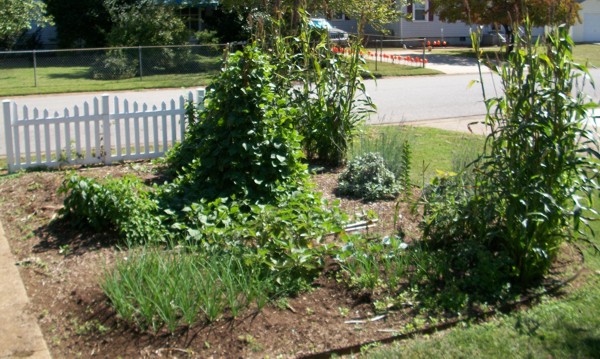
      The pole beans are doing really well, as they usually do for us when planted after the spring/summer bush beans stop producing.  We've picked a few meals worth, but this bountiful harvest will have to be canned, we are only two people after all!   A note on the beans, I planted 8 seeds, one in each corner of two 4'x4' beds, seen below, the teepees.  After picking these, I think I'll vote for going back to growing them on hogwire fencing or we'll go with cattle panels.  The teepees may look cute, but most of the beans are below waist or knee level and I'm too old for very much stoop labor.  Maybe taller teepees, but we made these as high as I could reach.  Gardening is experimenting!

Lavendar and sage are some of my favorite herbs.
    The basil is still growing and I'm cheering on the 'lettuce leaf' plants we grew from last year's seed.  It did wonderfully this year, but is a bit slow making seed.  I hope it makes it before frost!! 
    In the garden and growing for next season is cabbage, onions, lettuce, carrots, beets, turnips.  Kale is waiting to go in the ground.  Cilantro is coming up everywhere from seeding itself early this summer.  Hope The Farmer didn't get it all when he 'weeded'.
Heirloom bunching onions from a friend in Lacey's Spring,
eggplant still hanging on, cabbage growing, peppers giving it
their all, sorghum cane that will not turn brown, sages, lavendar and
cilantro.

     That's where we are as October starts... how does your garden grow?

The Farmer's Wife

Thursday, March 24, 2011

Special Request - Anti-inflammatory Veggies

Thought I'd share a bit of research...and ask for any other suggestions on anti-inflammatory vegetables you can grow for yourself.  If this is a concern of yours, you may want to concentrate on the following:

Peas - most of the legumes, the green spring and the later summer ripening ones
Sunflower Seeds - choose varieties that are for eating, not just beauty
Shitake mushrooms - keep your eye out for classes that will include an innoculated log!
Ginger in front of beans
and a couple of pepper plants

Ginger & Turmeric - root 'spices' that are pretty too! Mulch heavily in winter.
Garlic - easy to grow, tastes great..and good for you!
Broccoli / Cabbage / Collards - mostly cool season crops around here
Onions - winter bunching onions and summer bulbing
Carrots - plant lots in the fall and pull 'em when you need 'em
Spinach - green leafy veggies
Sweet Potatoes - another easy to grow crop if you have the room...and keeps well through the winter
Strawberries - sweet and juicy
Blueberries - I have to share most of mine with the birds, but worth fighting for!
Cantaloupe - melons come in a variety of shapes and tastes, try some heirloom seeds and give them room to grow

Some sources say that peppers are anti-inflammatory.  If they seem to be ok for you, there's a wide variety to experiment with from sweet to fiery hot. 

GentleVoice

Tuesday, March 15, 2011

A lot going on...

Warmer weather means it's the last chance to get the cool season crops in and out before hot weather, so we planted out some of the beds that we've cleaned out or left fallow over the winter. 
The bed numbers correspond to the layout on Garden Beds page. if you want to follow along!
Right now, we have


Enough for 2 people all season!
  Collards in Bed 3 (pictured)- we've eaten off these all winter and they are still going strong.  Next time you have fresh ones, saute in olive oil with some garlic and onion...and seasoned salt (the miracle seasoning)  They'll stay until they start to bolt.
Bunching onions in Bed 4 - which are just starting to bulb out and will come out soon
Red Russian Kale in Bed 8 - again, staying until it's time is past, giving us a "mess" every other week or so. This bed also had some cabbages, which are now eaten...so I threw some cilantro seed into the bare half of the bed.
Various herbs in Bed 12 - parsely, thyme, sage, garlic and a couple of struggling lavender which The Master Pruner pruned rather harshly, but I am assured it will be happer for it.
Bed 9 has a couple of Chinese cabbage plants that I'm going to save seed from.  The brassicas put on a very pretty early spring show of yellow flowers!
On to new plantings....
Bed 10 - The carrots ran out a couple of weeks ago, so that bed got some Tendergreen mustard, Bibb lettuce and radishes for quick salads in 2-3 weeks.
Bed 11 -  Spinach followed beets here, so they'll be ready for thinning to add to the salad soon.
Bed 5 -  This bed is a no-till/mulch/pile it on bed and got it's first seeds... Multicolor Chard.  I only planted the outside few feet closest to the driveway, I'm hoping it will look pretty since it can last quite a while into summer.  We can plant something not quite so attractive 'inside'.
Bed 6 - I'm trying some Giant Red Mustard here...it's coming up slowly
Steel rod to firm soil and make seeding rows,
just press, then plant!
Bed 7 - Detroit Red beets - More thinnings for salads and then there should be enough in the bed to warrant a canning session or two.  After we eat fresh ones, of course. 
Along the front fence, the peas are growing quickly, I just hope it doesn't warm up too soon.  I got them in a little late this year.  I think from now on, I will sow in the fall and let them hibernate at 2" tall like they did last year, that was my best pea crop ever.

In the back yard, I set out some tranplants of red cabbage, Joi choi,  Chinese cabbage and a flat early dutch or two.  I have some Napas of two varieties in flats, but one was almost a total failure, while the other is up and going in 48 of 50 cells.  No clue what happened, I planted them the same day, same soil mix.  Isn't gardening fun?

How's your spring going?
GentleVoice

Sunday, February 6, 2011

2-6-11

We just harvested some Chioggia Beets and some sweet crunchy carrots for supper tonight. They had been mulched under, self storing if you will, in one of the front yard beds. I am getting a little antsy and wanted to begin bed prep even though I know it is way too early unless I protect the seedlings or transplants in any bed right now.


Beets are cool in that if you pull the biggest ones, you encourage the smaller ones to keep growing. The Chioaga is interesting to look at, but I prefer a more traditional beet. The look and taste of Bull's Blood or Detroit Red is what I think of with Beets.

The carrots just make me smile, what’s not to love? Orange roots and feathery greens, great taste and a nice meal on a warm afternoon to start the second week of February.

Now if the firewood will hold out. We have burned 2 cords so far and have one and half to go. Hoping for that week of 60 and 70 degree temps we used to get before a big freeze. Every day I don't have to burn wood in February is another day in March I can. We use logs from local tree companies who have removed a tree nearby. I prefer to get my wood in February or March. The old saw is “wood warms twice”. Wood warms several times. Once when first cut, twice when hauled to my property, third when cut to woodstove length, 4th when splitting and 5th when stacking it. I can think of a 100 things to do besides cutting and splitting wood when it is hot outside.

Sunday, January 23, 2011

Cucuzzi - Feed a Family with One Fruit!


       Here is a great plant for vertical gardening. This gourd does grow fast and long. I pruned ours to keep it within the bounds of its area and it did not mind at all. This gourd needs sun, we planted it at a defined shade line and it grew totally toward the sun side. With 20' of growth on one side and 1' on the shade side. Though it is a consistant producer, we were not overwhelmed with numbers. We had zero issues with insects or diseases. Squash and stink bugs stayed away although they were feeding nearby. We had a great harvest from 2 seeds. We covered the plant for several freezes and pulled the last gourds at Christmas.

      Potential sites includes arbors, fences, or perhaps trellising against a south wall to provide shade. Give this one room to run or train it to grow along the fence or arbor. Ours grew up and out of a tomato cage and along the ground and then climbed another cage 8' away. The bed width where we tried the plant is 4', to maintain access I pruned the plant 2x during the growing season. The cucuzzi took the hint and tried to stay inbounds and grew along the bed very nicely.

       Our favorite way to eat them is to cut them into 1/2" squares, stirfry in olive oil with a little salt and pepper. We think it tastes like a bite of meat. We often include it in dishes, but this one can stand alone on the plate. One gourd can make several meals.    

     Ours came from Lincoln, AL where they are simply called "Long Gourd" cucuzzi.  Also known as Hercules's Club and other imaginative names.

Lagenaria siceraria -- Vine growth is very vigorous. Leaves are large with a soft, velvety texture. Leaf margins are irregular but not lobed. Tendrils are long and forked. Vines have a musky scent. Flowers, which are perched on long, slender stems and have a sweet scent, bloom only at night and are pollinated by moths. Fruit size varies from medium small to very large. The mostly thin-shelled fruit can be dried to form a mostly empty shell. Seed size and color is too variable to delineate.  (from Commercial Production and Management of Pumpkins and Gourds Edited by William Terry Kelley, Extension Horticulturist  David B. Langston, Jr., Extension Plant Pathologist)

Sunday, December 13, 2009

Tis the season...to be busy!

A quick note to remember what was in the garden this day....
turnip greens, turnip (purple top), collards, cabbage (smooth) and savoy, buttercruch lettuce, chinese cabbage, onions (purple),  bunching bermuda (heritage), sage (! even the annual), rosemary, thyme, lavendar (! blooming?) oats and wheat hanging in there...ah, the garlic (elephant).
Not too bad :)   and very thankful for the bounty of the summer in jars and freezer. 
A quick peek at the website soon!!

GV