Google Earth can be entertaining on a rainy November afternoon. I discovered the 'historical' image tool today and wandered off to find our house. The first image from February 2002
You can see the house with the front yard bisected by a walkway. The driveway is on the upper side of the house with a patio in the ell and garage to the back. Trees shade the whole backyard and the front is grass. Well, short green plants, some edible like dandelions and dock and hmm...well, ok other weeds. Forward to June 2006
Closer than this and it begins to look like pointillist art, but you can see the back yard has lost some tree cover and the front yard is dead grass/dirt being prepared for gardens. March 2007 is much clearer.
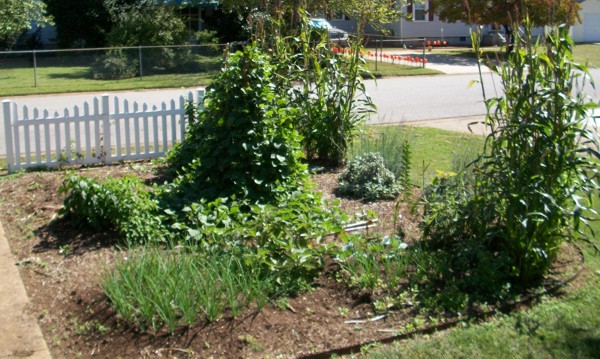
The trees are not in leaf yet, so you can see the back and front pretty well. The front has gardens with grass strips around them, there is a single fence across the front of the gardens. The fence helps the place look nice between crops and provides some support for vining plants like peas, hyacinth bean vine and the like. In the back, you can barely see some white X's, those are square foot gardens placed corner to corner. The X's are PVC pipe to make little hoophouses. You can see them closer here. The light 'trail' on the lower side of the house is our lesson on buying 'soil' and letting it be dumped without examining it. River silt is not good on gardens. Quite a contrast with the dark lovely soil Lee has created in the front yard, isn't it? Soil conditioner and compost are your friends when starting a garden.
The latest shot is from September 2010...
The front fence is covered with hyacinth bean vine..as is the arbor over the sidewalk. Gorgeous vine and vigorous grower. We won't grow it over an arbor again as we had to spend way too much time pruning so we could get to the street!
A note on tree cover. If you'll notice in the first shot above, the trees in the upper rear corner of our lot shade that area. They were spindly tired pine trees and by the third shot they are gone. You can see that by 2010, the neighbor's river birch again overshadows that rear corner. This isn't a problem for us as that tree is to the north, our cherry on the south side(which almost melds with our southern neighbor's maple) shades most of our back yard. However, when you are figuring out where to put your garden, watch out not only for shade or future shade from your own trees, but those of your neighbors as well.
The blog of Foodscapes, Huntsville's Urban Farmer and Food Advocate ~ Let's talk about Local Food, Vegetable Gardens, Edible Landscaping, Community Gardens, Food Systems, Sustainability and Resilience
Showing posts with label 4 season gardening. Show all posts
Sunday, November 27, 2011
Tuesday, October 25, 2011
Learning more!
Tis the season for conferences, seminars and workshops it seems. Lee is off for a few days to Birmingham for Alabama Urban Forestry / International Society of Arboriculture (gotta keep those CEUs coming) conference so I slid into the Master Gardener's Fall Workshop at the Extension Office ACES on Cook Ave today in his place.
First up was Dottye Pierce (President MGNA) and Ken Creel (extension agent for this area) for the welcome and overview of their organizations. Then we were treated to Janet Boothe's talk on Flower Bulbs. Such gorgeous pictures of all the types of tulips and daffodils and crocus as well as the more unusual frittaria and snowdrops. New to me was the botanical species tulips, the forerunners to our modern hybridized tulips.
She included lots of good information on planning and planting so I hope to see more bright colors around town!
Ed Gray spoke next on cold frames. TONS of good ideas here from the simplest to the most elaborate. I loved the hay bales with an old window on top, wish I had a picture! The essence of cold frames is to capture the sun's light and heat and protect plants from drying winds.
Stacy Scannell from the Botanical Garden gave us a powerpoint tour of the greenhouses and cold frames of all kinds that they use to keep the plants coming in all seasons. From simple wood boxes with wire screening on top to keep the critters out to an automated greenhouse that heats and cools and opens and closes as needed, the Garden has something to suit every plant.
Karen Voelker hauled in a sampling of the produce currently on tap at the CASA garden. Radishes, kale, curly mustard, cucuzzi squash, okra (still!?) , turnip (root and tops) and spoke about growing everything under the sun. Her main message? Rotate crops, compost and keep planting! Seeds are cheap and you never know what will grow :)
Max Campbell is a joy to listen to. You don't just get his wisdom from 40 years of vegetable gardening in this area, he throws in the years before that (ahem not sure how many) and his father's nuggets too ! He covered about all the topics you could ask for from seeds to tools and included a great list of ACES publications and other resources for the attendees.
Not sure where we'll end up next, but we'll learn something new! Have you picked up any fall or winter garden tips lately?
Shannon McBride
First up was Dottye Pierce (President MGNA) and Ken Creel (extension agent for this area) for the welcome and overview of their organizations. Then we were treated to Janet Boothe's talk on Flower Bulbs. Such gorgeous pictures of all the types of tulips and daffodils and crocus as well as the more unusual frittaria and snowdrops. New to me was the botanical species tulips, the forerunners to our modern hybridized tulips.
![]() |
| Tulipa chyrsantha - Courtesy Wiki Commons |
![]() |
| Tulipa turkestanica - Courtesy Wiki Commons |
She included lots of good information on planning and planting so I hope to see more bright colors around town!
Ed Gray spoke next on cold frames. TONS of good ideas here from the simplest to the most elaborate. I loved the hay bales with an old window on top, wish I had a picture! The essence of cold frames is to capture the sun's light and heat and protect plants from drying winds.
Stacy Scannell from the Botanical Garden gave us a powerpoint tour of the greenhouses and cold frames of all kinds that they use to keep the plants coming in all seasons. From simple wood boxes with wire screening on top to keep the critters out to an automated greenhouse that heats and cools and opens and closes as needed, the Garden has something to suit every plant.
Karen Voelker hauled in a sampling of the produce currently on tap at the CASA garden. Radishes, kale, curly mustard, cucuzzi squash, okra (still!?) , turnip (root and tops) and spoke about growing everything under the sun. Her main message? Rotate crops, compost and keep planting! Seeds are cheap and you never know what will grow :)
Max Campbell is a joy to listen to. You don't just get his wisdom from 40 years of vegetable gardening in this area, he throws in the years before that (ahem not sure how many) and his father's nuggets too ! He covered about all the topics you could ask for from seeds to tools and included a great list of ACES publications and other resources for the attendees.
Not sure where we'll end up next, but we'll learn something new! Have you picked up any fall or winter garden tips lately?
Shannon McBride
Monday, October 3, 2011
Fall is for Food from the Yard!
October already! Just a few more days til the traditional first frost date of October 15th. So what's in the garden and on the table?
Bell peppers are racing to beat the frost. Little HOT (very hot) peppers (hot lemon) that will make a great bug repellent spray when dried and steeped next year. Reliable Jalapenos are still coming, some for the salsa, some for the bug spray next year. Tomatoes, of course, smaller and fewer than they have been, but still producing! Horseradish is there somewhere, not sure it was real happy in the sun, but it did make root, so we'll grate and freeze or pickle for some spice this winter.
The sorghum cane made pretty seed heads that the birds attacked, but we rescued a few for some hot cereal when the weather is really cold. The cane is still green and making suckers and still sweet when cut and chewed. I have to watch the Farmer so he doesn't come home with a millstone to crush them into syrup.
The basil is still growing and I'm cheering on the 'lettuce leaf' plants we grew from last year's seed. It did wonderfully this year, but is a bit slow making seed. I hope it makes it before frost!!
In the garden and growing for next season is cabbage, onions, lettuce, carrots, beets, turnips. Kale is waiting to go in the ground. Cilantro is coming up everywhere from seeding itself early this summer. Hope The Farmer didn't get it all when he 'weeded'.
That's where we are as October starts... how does your garden grow?
The Farmer's Wife
![]() |
| This was all gathered Sunday, or canned, as the case may be. |
The sorghum cane made pretty seed heads that the birds attacked, but we rescued a few for some hot cereal when the weather is really cold. The cane is still green and making suckers and still sweet when cut and chewed. I have to watch the Farmer so he doesn't come home with a millstone to crush them into syrup.
The okra is still coming, again slowing down, but we always have some til frost. The Red heirloom okra deserves a place in the edible landscape (see below). It is a lovely plant, open and uniquely colored. The fruit is plentiful and very good. The Farmer loves it raw, eating it as soon as he picks it. We're trying to do less fried okra, so he can have as much as he wants. We don't use the ginger in the foreground for the okra, but it does wander into some stirfry occasionally, and the winter squash will be happy to share flavors.
The sweet potatoes are the first we've dug, they went in a little late but they did well, we'll leave the rest for a while yet. The jars are full of Candy Roaster squash, ready for the pantry. There's a bowl of mixed butternut (picked Friday from the side of the house) and the leftover Candy Roaster from canning. That will go in a pie tonight, a bit of extra honey to sweeten the butternut and it will be as good as pumpkin (which is just another winter squash).
![]() |
| Right front basil trying to seed then tomatoes Left front butternut then sweet potatoes and a couple of blueberries at the fence |
The pole beans are doing really well, as they usually do for us when planted after the spring/summer bush beans stop producing. We've picked a few meals worth, but this bountiful harvest will have to be canned, we are only two people after all! A note on the beans, I planted 8 seeds, one in each corner of two 4'x4' beds, seen below, the teepees. After picking these, I think I'll vote for going back to growing them on hogwire fencing or we'll go with cattle panels. The teepees may look cute, but most of the beans are below waist or knee level and I'm too old for very much stoop labor. Maybe taller teepees, but we made these as high as I could reach. Gardening is experimenting!
![]() |
| Lavendar and sage are some of my favorite herbs. |
In the garden and growing for next season is cabbage, onions, lettuce, carrots, beets, turnips. Kale is waiting to go in the ground. Cilantro is coming up everywhere from seeding itself early this summer. Hope The Farmer didn't get it all when he 'weeded'.
![]() |
| Heirloom bunching onions from a friend in Lacey's Spring, eggplant still hanging on, cabbage growing, peppers giving it their all, sorghum cane that will not turn brown, sages, lavendar and cilantro. |
The Farmer's Wife
Sunday, February 6, 2011
Cheap? Repurpose? Grow Food!!
We at Foodscapes will be happy to create a more elegant solution to your 4 season issues. The following are some quick, easy and relatively inexpensive solutions for seed starting and row covers for young tender plants. These season extension tools can help you put food on the table earlier in the year and farther into the winter.
The arches are 1/2” conduit bent to a 4' diameter. The conduit comes 10' long and runs around $2.20 per stick.
The rope that is somewhat carelessly tied to the arches is to hold the plastic up to allow better access when working with the flats or transplants in the ground as the case may be. I am using clothes pins to hold the plastic up and out of the way.
This plastic is the good stuff. 6 mil UV treated clear greenhouse grade plastic 10' wide x 100' long before being cut to length for this project. I caught this on sale last fall. It is rated for 4 years of continuous service. We will only use it on a seasonal basis so hopefully it will last many, many years. Please note for 6 years we have used a good grade of contractor plastic which costs much less. We usually get 2 years of service out of the contractor plastic. By keeping the unused portions out of the sun, a roll can last a long time. The contractor plastic is opaque and does block more sun but again it is an inexpensive way to cheat the seasons.
The bed was already in place but needed weeding. I placed the bent conduit arches in on each side and pushed them in to the soil about 6” - 8” or so. In a longer run or row set up I could add a purling made from conduit and fastened with self tapping screws. There simply is no need for that with such a small structure. I measured twice and cut the plastic, draped it over and looked around for hold downs (sand bags, pots, bricks and a landscape timber). I purposely chose these materials to show this doesn't have to cost an arm and a leg to do. Sod staples, tent pegs would also work well. With a wood sided frame some cardboard or batten material and a staple gun could hold one or two sides.
The rope that is somewhat carelessly tied to the arches is to hold the plastic up to allow better access when working with the flats or transplants in the ground as the case may be. I am using clothes pins to hold the plastic up and out of the way.
The plastic teepee.
Here are some pictures from our early square foot gardens. I simply bought some ¾” plastic pipe cut it to fit inside the boxes. By placing the ends in the corners I avoided the need for brackets. Brackets can be bought or are easily made we chose to do without. We crossed the pipes and tied them together in the center and they lasted all winter. We used this technique with these beds for 3 or 4 years before the beds moved to another house to help our son get started gardening.We used the contractor grade plastic and dreamed of the good stuff, all the while cheating the seasons with early started vegetables.
This is our bed bed. This is a re-purposed frame from one of those high dollar air beds. We made a lasagna garden out of it last year or the year before, I forget now.
The rope that is somewhat carelessly tied to the arches is to hold the plastic up to allow better access when working with the flats or transplants in the ground as the case may be. I am using clothes pins to hold the plastic up and out of the way. This plastic is the good stuff. 6 mil UV treated clear greenhouse grade plastic 10' wide x 100' long before being cut to length for this project. I caught this on sale last fall. It is rated for 4 years of continuous service. We will only use it on a seasonal basis so hopefully it will last many, many years. Please note for 6 years we have used a good grade of contractor plastic which costs much less. We usually get 2 years of service out of the contractor plastic. By keeping the unused portions out of the sun, a roll can last a long time. The contractor plastic is opaque and does block more sun but again it is an inexpensive way to cheat the seasons.
The bed was already in place but needed weeding. I placed the bent conduit arches in on each side and pushed them in to the soil about 6” - 8” or so. In a longer run or row set up I could add a purling made from conduit and fastened with self tapping screws. There simply is no need for that with such a small structure. I measured twice and cut the plastic, draped it over and looked around for hold downs (sand bags, pots, bricks and a landscape timber). I purposely chose these materials to show this doesn't have to cost an arm and a leg to do. Sod staples, tent pegs would also work well. With a wood sided frame some cardboard or batten material and a staple gun could hold one or two sides.
The rope that is somewhat carelessly tied to the arches is to hold the plastic up to allow better access when working with the flats or transplants in the ground as the case may be. I am using clothes pins to hold the plastic up and out of the way.
The plastic teepee.

Here are some pictures from our early square foot gardens. I simply bought some ¾” plastic pipe cut it to fit inside the boxes. By placing the ends in the corners I avoided the need for brackets. Brackets can be bought or are easily made we chose to do without. We crossed the pipes and tied them together in the center and they lasted all winter. We used this technique with these beds for 3 or 4 years before the beds moved to another house to help our son get started gardening.We used the contractor grade plastic and dreamed of the good stuff, all the while cheating the seasons with early started vegetables.
Monday, September 6, 2010
Time for a Coooool Chaaannge
Like the lyrics of the song, it is time for a coooool change, the mornings now hold the first hints of fall, relief is just a few weeks away. It is time to fill those empty spaces in the garden with veggies that like cool weather. If you preserve food you may want to plant the entire crop at one time to avoid repeated setups of the canning equipment.
However, to be in the spirit of 4 season gardening and eating, don't plant all your vegetables at one time. Consider succession planting. Plant just part of your expected fall produce needs now and then keep planting new seeds and transplants every two weeks. Plant at least as much as you think you'll eat, you can always freeze some for later. Five separate plantings, two weeks apart over a 10 week period can extend your harvest over a 10 week period. This is the one big technique that sustainable farmers use to provide produce through such a large window of time.
Remember your rotation plan, don't plant in a helter skelter fashion, stay somewhat disciplined and try to group plants by family as well by moisture, and nutritional requirements. Of course, group plants by temperature range or frost and freeze tolerances as well. Four season food production is our goal and that is easier to do when you can protect whole rows or beds at one time instead of an isolated plant among hardy plants.
If you haven't already done so, start your Cabbages, Broccoli and perhaps Kale and Collards now. Direct seed Carrots and Beets. Remember Carrots really want consistent moisture for a week or more before they germinate. Try planting Radishes with your Mustards and other leafy crops this fall. The Radishes may help keep flea beetles and other pests away long enough for your plants to have a great start this fall. Start Black Seeded Simpson lettuce now, as the weather cools other varieties (including the wonderful Buttercrunch!) will follow.
The fall garden is my favorite gardening period. Weed pressures are much lower. Cooler drier air really brings the joy back into some of the chores. Don't forget to turn the compost pile, or go ahead and install some of that compost now on the beds where you will be planting fall and winter crops. Make plans to shred and keep those leaves this fall. If you don't have trees on your property you may have to resort to becoming a leaf thief. Leaves are a wonderful component for future composts, run over the leaves with your lawnmower and create a topical mulch for your onions and the beds you aren't using this fall and winter. Avoid bare soil if at all possible. Uncovered, bare soil is the fastest way to lose soil to erosion, and you lose the opportunity to build soil or add microbial life to your garden. Next year's garden will thank you for the mulches you create this fall.
Lee McBride
![]() |
| Plant now, enjoy sooner! |
Remember your rotation plan, don't plant in a helter skelter fashion, stay somewhat disciplined and try to group plants by family as well by moisture, and nutritional requirements. Of course, group plants by temperature range or frost and freeze tolerances as well. Four season food production is our goal and that is easier to do when you can protect whole rows or beds at one time instead of an isolated plant among hardy plants.
If you haven't already done so, start your Cabbages, Broccoli and perhaps Kale and Collards now. Direct seed Carrots and Beets. Remember Carrots really want consistent moisture for a week or more before they germinate. Try planting Radishes with your Mustards and other leafy crops this fall. The Radishes may help keep flea beetles and other pests away long enough for your plants to have a great start this fall. Start Black Seeded Simpson lettuce now, as the weather cools other varieties (including the wonderful Buttercrunch!) will follow.
The fall garden is my favorite gardening period. Weed pressures are much lower. Cooler drier air really brings the joy back into some of the chores. Don't forget to turn the compost pile, or go ahead and install some of that compost now on the beds where you will be planting fall and winter crops. Make plans to shred and keep those leaves this fall. If you don't have trees on your property you may have to resort to becoming a leaf thief. Leaves are a wonderful component for future composts, run over the leaves with your lawnmower and create a topical mulch for your onions and the beds you aren't using this fall and winter. Avoid bare soil if at all possible. Uncovered, bare soil is the fastest way to lose soil to erosion, and you lose the opportunity to build soil or add microbial life to your garden. Next year's garden will thank you for the mulches you create this fall.
Lee McBride
Saturday, January 16, 2010
What to eat?
Epicurios offers this interactive map on what's fresh in season. Short list! Georgia's is longer, and I think more accurate. We still have onions, a few collards, a cabbage or six. There would be parsely...but ::shudder:: I don't want to think about it. Turnips are coming up, so I guess they aren't considered 'fresh' anymore.
Sure glad the pantry is full. Some icefishing may be in order to vary the diet, but other than that, we're doing well!
One more month until fresh green things!!
GentleVoice
Sure glad the pantry is full. Some icefishing may be in order to vary the diet, but other than that, we're doing well!
One more month until fresh green things!!
GentleVoice
Sunday, January 3, 2010
4 Season Gardening?
Is "arctic" a season? 19 degrees and colder this week....time to work quickly on what little there is to do outside!
We'll cut and pull what we can, there's always canning or freezing. Not a good time to set out little seedlings, we'll just start some new ones for the next round as what I have ready is getting leggy. That's the good thing about starting seeds in pots. No backbreaking bending over to see if that peek of green is a seedling or a weed. Little wasted seed (I always overplant in the beds).
Seed starter pots and homemade seed tape...the keys to properly spaced plants!
Back to the fire,
GentleVoice
We'll cut and pull what we can, there's always canning or freezing. Not a good time to set out little seedlings, we'll just start some new ones for the next round as what I have ready is getting leggy. That's the good thing about starting seeds in pots. No backbreaking bending over to see if that peek of green is a seedling or a weed. Little wasted seed (I always overplant in the beds).
Seed starter pots and homemade seed tape...the keys to properly spaced plants!
Back to the fire,
GentleVoice
Tuesday, December 22, 2009
Listen carefully...
The nice USDA lady mentions that the size they are putting up is a good size for a home garden. The farmers' being larger of course. The hoophouse program is based on 20'x100' hoophouses. These do a wonderful job in our climate of letting you do 4 season gardening. (yes, I know the link isn't live yet, but soon!)
You won't do tomatoes and eggplant in December, but you can do lots of greens and cabbages and root crops. And those are just as wonderful...fresh from your yard!
GentleVoice
You won't do tomatoes and eggplant in December, but you can do lots of greens and cabbages and root crops. And those are just as wonderful...fresh from your yard!
GentleVoice
Sunday, December 13, 2009
Tis the season...to be busy!
A quick note to remember what was in the garden this day....
turnip greens, turnip (purple top), collards, cabbage (smooth) and savoy, buttercruch lettuce, chinese cabbage, onions (purple), bunching bermuda (heritage), sage (! even the annual), rosemary, thyme, lavendar (! blooming?) oats and wheat hanging in there...ah, the garlic (elephant).
Not too bad :) and very thankful for the bounty of the summer in jars and freezer.
A quick peek at the website soon!!
GV
turnip greens, turnip (purple top), collards, cabbage (smooth) and savoy, buttercruch lettuce, chinese cabbage, onions (purple), bunching bermuda (heritage), sage (! even the annual), rosemary, thyme, lavendar (! blooming?) oats and wheat hanging in there...ah, the garlic (elephant).
Not too bad :) and very thankful for the bounty of the summer in jars and freezer.
A quick peek at the website soon!!
GV
Saturday, November 21, 2009
New Beds and Renewed Beds
The coming week? An essential tool list, a couple of recipes (it is Thanksgiving) and more pictures!
Subscribe to:
Posts (Atom)